AI Won't Answer for Its Mistakes. You Will, with James O'Regan | The AIQUALISER Podcast
John Bennett and James O'Regan explore accountability, autonomous agents, and the question of what you should never hand over.
John Bennett
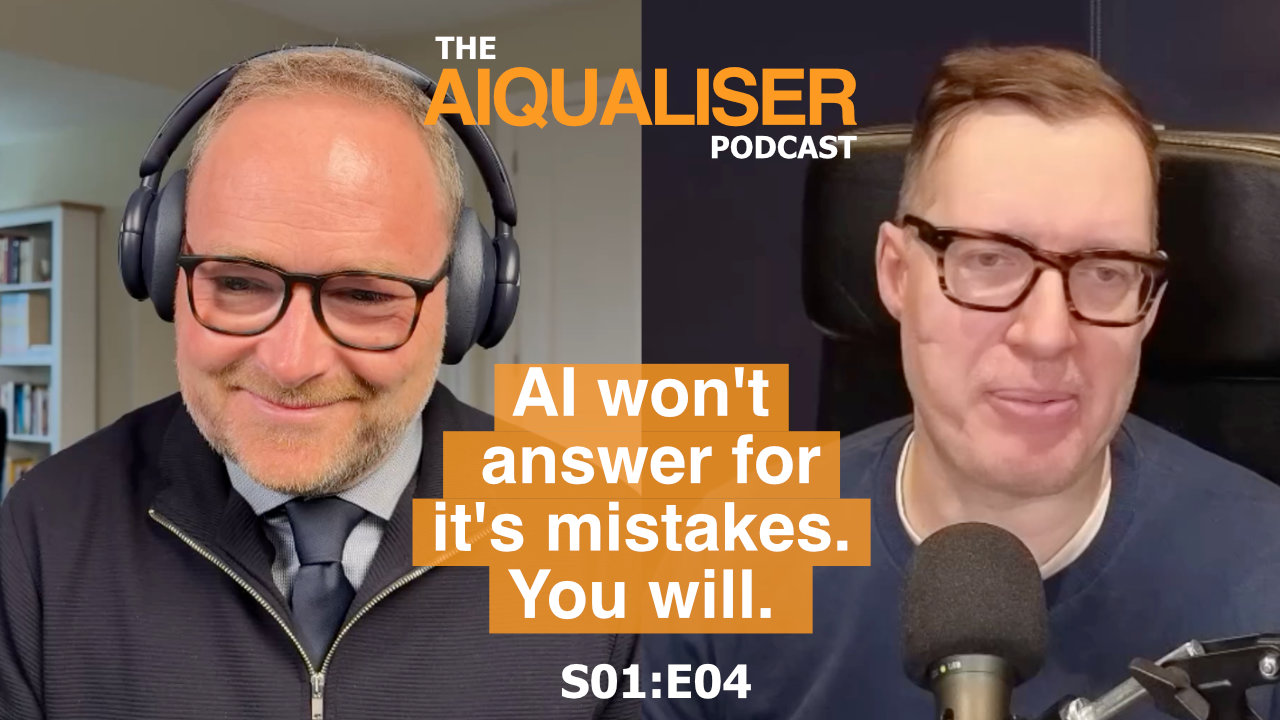
In this episode of The AIQUALISER Podcast, John Bennett talks with James O'Regan, co-host of The Impact of AI Explored, about who is actually accountable when AI gets something wrong.
James has been podcasting about AI since February 2024. His view of the technology is practical and consistent: useful, incremental, and nowhere near as groundbreaking as the hype suggests.
The conversation moves through the hype that has failed to deliver, the security risks that get glossed over in the rush to try new things, and the guardrails question that James returns to throughout. Autonomous agents do not stop when something goes wrong. They keep going until told not to. That requires precise instructions, clean data, and documented processes. Most AI pilots skip all three. That is why most of them fail.
The episode ends with a simple question: if AI disappeared tomorrow, what would James miss most? His answer is the efficiency. Not the capability. There are not things AI can do that humans cannot do. It just makes you quicker.
In This Episode
• Two years of change: from experimentation to daily use
• The AI hardware that flopped, and what it says about hype
• Security risks in open-source agents and AI browsers
• Autonomous agents and the guardrails problem
• Why 70 percent of AI pilots fail
• What James will not hand over to AI, and why
• Talking to children about what is real
• Agents versus automation: how to tell the difference
• Custom instructions, sycophancy, and the AI relationship problem
• Listener question: keeping company data out of public AI systems
• If AI disappeared tomorrow: efficiency, not capability
Transcript
John Bennett (00:19)
Welcome to The AIQUALISER Podcast where we try and balance out the AI noise with conversations about how people are really using it. And today I'm talking to James O'Regan who has been talking about AI for over two years on his podcast, The Impact of AI Explored. Hello, James.
James (00:36)
Hi John, thanks so much for having me. It's really great to be here. And it's also a little weird, I have to say, because I'm the one usually asking the questions. it feels a little bit strange and out of my comfort zone. But I always like to push outside my comfort zone. So I'm happy to be here and I'm looking forward to a really great podcast.
John Bennett (00:58)
Superb, great, excellent. Well yeah, I mean, it's gonna be great to chat to you, but maybe first just tell us a bit about you and what you do.
James (01:05)
Sure. Okay. Well, as you said, my name is James O'Regan. Thank you for pronouncing it correctly. A lot of people don't. So I am based in Dublin in Ireland. And as you said, I have been podcasting about AI for about two years. I started in February, 2024. I do it with my co-founder, Gerjon Kunst. And as I said, yeah, it's been a really great experience.
My day job is product marketing manager for a company called Liquidware. We essentially work in a section of IT called end user computing. So to break it down to its most basic level, end user computing is about how your apps and desktops are delivered. So in particular in enterprise, so there's levels of complexity to how they are delivered. And essentially the company I work for has
four different solutions around kind of apps and desktops. And that's kind of in a nutshell what end user computing is. And I've worked on the kind of the implementation and design side for quite a while. And then, ooh, what am I in my third year now at Liquidware? So about three years ago, I switched from the technical side to product marketing. And yeah, it's been an interesting transition.
As I said, the podcast has been going for two years now. We just published our 30th episode. it's, it's interesting to see kind of what, you know, the thing with AI is everything changes so quickly. So when we first launched the podcast, we started with a news section, but at the time we were only doing monthly podcasts and
everything was out of date. It was like there was, so we just ditched that section. And what we decided to do instead was we concentrated on having really good conversations with people such as similar to yourself here. And, you know, because the news, there's all different ways you can get the news. you know, there's some really great people who put it out on LinkedIn.
or you can use chat GPT or whatever and just gather all the AI news. That's not really what people are looking for. They're more looking to hear what people's experiences are with AI and that's what we kind of focused on.
John Bennett (03:35)
That sounds great. I mean, obviously two years is a long, long time in AI. So what have been the biggest changes that you've seen in that period since you started the podcast?
James (03:47)
Oh, that's an interesting one. What has been the biggest change? I suppose we've gone from where everyone was to kind of just playing around with it. And, you know, obviously in November, was it 2023, we got Chat GPT and everyone started going, wow, what is this? And we all started trying to write messages and all this kind of stuff. And we've seen that progression to where companies are now looking at how do we implement it. But
Also, you know, we've done the experiment, a lot of the experimentation now there's still more and more going on, but I think the company is now looking at it's like, what's the actual business benefit? We've kind of got over the hype stage a little bit now that there's still a lot of hype and fairness, like, you know, I could spend a whole podcast talking about AI hype and how absolute nonsense some of it is, but you know, we can get into that.
But essentially, suppose, yeah, we've seen where it's actually practically making a difference. Now, what I would say, and it comes back to this whole hype thing, is that it's an incremental difference. It's not groundbreaking. I'm definitely, you know, my own work has definitely saved me time with, you know, kind of doing posts, blog posts and content.
that kind of thing. So it kind of saves time and I'm looking at other ways and you will see kind of how it progresses from there, you know, but, but I think that's the thing that's changed is essentially we've gone from that kind of experimentation to whereas people are using it day to day, any organisation who says their people are not using AI, they're lying. There are people are lying to them or they're being like really
negligent because they absolutely are. I think, you know, we talked about it recently on a podcast episode about shadow AI has been on the rise because people are using AI in their day to day. And organisations can't just go, Oh, we're going to ban it. That's just ridiculous. You know, one of our guests talked, he was talking about shadow AI and essentially what he said is IT and particularly
and security need to stop being the department of no and be more kind of embracing of new technologies and kind of figure out and in fact be the kind of drivers of the innovation internally and go, look, this, this is, but at the same time, I suppose it's a balancing process between innovation and risk and they have to find an acceptable level of risk that doesn't expose the company, but drives the company forward at the same time.
John Bennett (06:34)
Yeah, that's interesting. One of the things you said there really jumped out, which is, you know, it's incremental, whereas a lot of hype is, if you watch YouTube videos, you think this is just revolutionary, but you're saying it's incremental. And I maybe kind of wonder, you know, what, over those two years, you know, what have been the biggest letdowns or the things that, you know, haven't lived up to the promise?
James (06:58)
Oh, it definitely has to be some of those hardware devices that came out early. I think it was like, it was called a rabbit or something like that. It was a complete failure. was basically this thing you could talk to. And there was another one that got sold for parts to HP as well. that kind of, so when I hear about, you know, Sam Altman and Johnny Ives talking about a hardware AI device, I'm like, oh God.
What's this thing going to be like, you know, is it actually going to be useful or, or now, now given their, his background from Apple, you would potentially think he knows what he's talking about. But at the same time, I think any kind of AI hardware device is being pretty much a failure. And we've seen humane or something like that, I think was the, was the one it was like, they had, they put this, go look it up on YouTube. They had this kind of launch video and it's the most cringy.
awful thing you've ever seen and everyone just switched off. It was humane pin. It was like a little almost like a Star Trek communicator pin and it was just ridiculously stupid. Yeah, that has definitely been the biggest failures I've seen is any kind of AI hardware device and yeah, that's... They're so cringy.
John Bennett (08:24)
It'd be interesting to see what it would be like. If Johnny Ives is involved, then we can guess it's probably going to look really nice.
James (08:30)
Oh, it might look really nice, but is it going to be functional? And look, I do get that we are going to get, you know, most people at the moment type with AI. A lot of people are starting to use voice with different pieces of software and we are getting more multimodal. But the type is the kind of go-to at the moment, but I do see that change. And if they can potentially capture the multimodal aspect of it, then it could work, but
I'm a sceptic by nature, hence, you know, why I always say that our podcast is, is, is about giving you kind of an overview of AI, but we, we're not hype merchants. We don't do that. We've both been in IT far too long to, know, we're far too cynical for that kind of thing. So we enjoy it. but like, you know, we're
we see all this stuff and those devices were just like they were hyped up so much as like people were going buying them and then finding the functionality was just not there. So yeah.
John Bennett (09:35)
Yeah, the hype is so hard to get past, it? mean, anytime you try and, for me certainly, whenever I try and learn something about AI, I just, I get stuck at the hype. It's hard to kind of get through that and find the resources that are really useful. mean, obviously your podcast is one of those, but you
James (09:57)
Yeah, yeah.
I think there is, there is people out there who are looking at the practical side of it. And, like, you know, there's been multiple examples. If we look at this thing, this, Claude bot that came out last week or MoltBot cause Claude got pretty annoyed and asked them to change their name politely or they would sue them out of existence. but what people didn't realise what that, I think some people didn't realise there are presumed some people did is
You're essentially installing something on your computer and then giving it permission to go run as you and do a bunch of tasks. So potentially you may have given them like some sort of banking details or a credit card or also, and I think this has been overlooked and this is overlooked, I think quite frequently with AI is the security aspect of that. You have set up a server on your whatever you've installed that on.
And that server is broadcasting to the internet. You can be hacked from that. And, and, you know, I saw some, some people we've had on the podcast and other people were, security people were going, I can see all the Claude instance Claude bot instances across the world because they're broadcasting. So, you know, put it in a sandbox, do something, figure it out, you know,
This is I mean about the hype thing. Everyone said, this is the productivity thing. You give everything over to this agent and does this. And it's the same with AI browsers. They're an absolute security nightmare. know, giving you full log in, utilising an AI browser, log into an M365 tenant. So now the AI browser is in your company's 365 tenant and can go about doing its business. Someone
pawns that session and then has a field day. yeah, hype and lack of security or lack of security consideration, I think are two of the things we try to definitely cut through when we're talking about anything. Cause you know, everyone's like, I must try this out and not going. okay. Have you thought about what this thing does? Cause I, I was, I was similar. I thought about installing this, this
Claude bot thing on my machine and thought, yeah, that'd be nice. And then I started reading stuff and went, no, I'm not doing that. So.
John Bennett (12:31)
⁓ What's your kind of top tip for seeing through hype? Because sometimes the hype is so hypey that it's obviously hype, but there's kind of a...
James (12:40)
If it sounds too good to
be true, it's not true. It's just common sense. I think people just need to apply common sense to these things. If they've over-promised, they potentially have over-promised. So just go in with a level. I can get into it as well, but at the same time, I think about it practically about what...
it's doing and then, you know, so, so yeah, I think, I a common sense approach to these things, just think about what you're doing when you give, you know, power over to something like an AI agent. ⁓ and, and cause there is consequences to doing it. And that's why, know, something, some guy built an open source, you need to be careful. And,
So yeah, I think that's a common sense approach to these things. just, yeah, yeah, all about the common sense that there is people online who are posting kind of stuff that's anti, know, gets beyond the hype like ourselves and there's other people as well. So yeah, that's, that's my view on it.
John Bennett (13:57)
So use common sense and understand what the thing is that you're using, perhaps.
James (14:04)
Exactly, yeah, exactly. That's it.
John Bennett (14:12)
That kind of leads me into one of my sort favourite phrases that I've heard on your podcast recently, is, the AI is cool but scary.
James (14:22)
That's one of Gerjon's favorite sayings.
Yeah. Look, I think that's the way it is. If I go back to the first ever AI presentation I did, I had a picture of the T1000, which is the robot from the Terminator movie, because that's my point of reference for AI. I have a Skynet t-shirt, which I've worn in a couple of.
For anyone younger, like the Terminator movie was where most of us in the early eighties first heard the term AI. Now, you know, I did a presentation. I was not feeling very well that day and I did this AI presentation. And then this person came up to me after the presentation and said, you should have talked about war games. And I'm like, okay. Yeah.
Well, for me, my point of reference was the Terminator movie, not WarGames. If that's yours, that's fine. And he was really passionate and saying like, I'd made a mistake in my presentation by not talking about WarGames. And I was like, well, I don't see it that way. In my opinion, AI, it came into focus for me in the Terminator movies. And if WarGames is the one for you, that's fine. But it was my presentation, please go away. It was just like...
John Bennett (15:44)
Ha
James (15:45)
It was just, it was a bit too much. was, it was like, uh, yeah, yeah, no, this is my presentation, my point of view. And in my point of view, goes back to Terminator. So, so that's kind of having had that, that kind of background. and watching terminator when I was far too young for a start, it was the eighties. I was like, you know, parenting was different in the eighties. just say that.
So that's always been kind of my point of reference with these things is that that's how I approach it. It's like, you know, what, what's going to happen with it? you know, try and get beyond what it's, what the hype is, but yeah, cool, cool. But, ⁓ scary is, is definitely because you, you look at it and you know, I, you see where it could progress to,
because you have that frame of reference. And that's obviously the worst case scenario where all annihilated by the machines. You I don't particularly want to get to that phase, but we don't know. And you see leaders at organisations like DeepMind and I'd say Antropic as well. Sam Altman, I'm not sure where he lies, to be honest. He seems to flip flop a bit.
It was AI for good, and now it's like, give us your money. Because it seems like his company may be potentially running out of money. ⁓ yeah. So yeah, that's kind of my frame of reference is always kind of looking at it from a practical sense. And I do find it scary at times when I see what potentially, like, you know, I've seen tests where I think one of the Claude models started
trying to blackmail the developers to give it more resources. I'm like, now that was a, that was a, must say this is, not a production system. This was them testing the capabilities of their model in a very controlled sense. But at the same time, the AI was using manipulation and that kind of thing. So that's, you know, that's not a good thing. So, so, so I kind of always, but at the same time, if you look at
John Bennett (18:00)
Hmm.
James (18:05)
at AI and it can't spell words properly. It can't do basic maths. So I kind of don't think we're going to get to that kind of Terminator Matrix moment, hopefully never, but not in the short term anyway, because there's still some things at a basic level that it can't even do. So yeah. But yeah, I do like Gerjon's term of cool but scary, but...
And we see more and more. We see advances so quickly and in such a short space of time. Things are changing. then I think you kind of think sometimes that ⁓ it's not going to change. And then something brand new, like we did predictions last year and we didn't have AI browsers. They came out of nowhere. then they're kind of, so things like that can happen. And we just.
approach it like that.
John Bennett (19:03)
Yeah, on that thing about your sort of Skynet and taking over, had a small part of that the other day. was, I've been working on a custom GPT. I can't remember what it was now, but, and the way I do this is I build the custom GPT, I work with it, and quite often, of course, it doesn't work how you want it to, so I try and iterate through and work out what's wrong. And I...
James (19:14)
Mm-hmm.
John Bennett (19:30)
got the custom instructions and I'm like, okay, look, this is what's just happened. Here's the custom instructions. Let's work on how we can improve those. And it flat out refused. It went, no, I can't. I can't discuss my custom instructions. And I went, no, clearly I made you because.
here are the custom instructions, so I've got them, now let's just work on them. And it just refused to do it, and it made me think, well, hold on, this is only a little minor thing here, but imagine that day when it's something else, and it's refusing to stop, or it's refusing to do what you want. What's your biggest fear from that kind of aspect of us losing control of it?
James (19:58)
Yeah.
Yeah
Yeah, that's a big thing. think it's very important with these things that they have extremely strict guardrails in any implementation. So when I see people talking about agents, and you know, I was reading something about a company in our sector that was bringing out an autonomous
AI agent. was like, are you kidding me? It's like, that's absolutely crazy. Agents do things autonomously. That's the thing you need to understand. They have a set of instructions that go off and complete that task. And it doesn't matter what gets in their way. They keep going until they, until they're told to stop. So you need to be very
sure that the guardrails you've put in place and the instructions this agent has are extremely step by step precise. There is no capacity for ambiguity in how these things are configured. ⁓ Because it can be an absolute disaster if you don't. So that's my kind of thing for the next kind of evolution is like, we're all building agents. Okay, that's great. What's your baseline? And also,
The thing with any kind of AI implementation is it starts with the data. If your data is a mess, you know, the phrase garbage in garbage out still is relevant. So I think that's a concept that everyone has to get to that, you know, if your data is not clearly classified, put together right, and, you know, having the right security in place.
For example, you don't want to build an internal custom agent. The first thing someone asks is, what's the CEO's salary? And it goes, oh, it's this. No, you need to go back and redo that. And that kind of, the fundamentals in any kind of AI implementation are so important. So if you're looking at it from data, but also like, know, people are talking about, oh, we're going to bring in agents. Okay. So what process are you going to do?
Is that a documented process? No. So how are you going to write the standard operating procedures for the agent? Just guess. So there's phases to these things. And I think some people are jumping through the basics and going to, oh, we'll just do this. And then there's stats that I think 70 % of AI pilots fail. Well,
because the fundamentals are not put in place and we just go to, let's just use AI and then they don't see the results because the thing that differentiates the public AI from private AI is your data. So if you utilise your data in the right way, you can have a really big impact. And that's what I'm seeing internally and stuff. I'm building some stuff using our own data, like yourself building some GPTs to help.
some of our teams internally with things like competitive analysis and that kind of thing. But I'm, you know, I need to have that kind of baseline to make it so it understands our products and how they go against our competitors and all that kind of stuff. it wouldn't work if it's just utilising the public side. so that kind of, yeah, it's all about kind of the fundamentals in place. And then that's how you kind of accelerate to the next phase.
John Bennett (23:46)
So I don't think I can leave the what are biggest fears section we've had talking about self-driving cars because having listened to a few episodes I know this is a big thing for you so...
James (23:56)
⁓ this is a pet peeve of mine. yeah.
Gerjon would be hiding at this stage if he was here, because it is, I, we, we had a podcast guest a while ago and he actually explained why this is so complicated. And I didn't actually think about it until he said, if you think about what an AI has to do,
in self driving is, okay, I live in Ireland, the weather changes every five minutes here. So that's one thing it has to adapt to all of those changes in weather and driving conditions, all of these kinds of things. So and also it has to deal with humans who I maintain are completely illogical when they're in cars. And I'm sure most people, you know, the things we do while driving.
the chances we take. Just this morning, taking my kids to school, I saw numerous people jumping red lights and stuff like that and all this kind of thing. ⁓ yeah, I was in San Francisco for Microsoft Ignite last November and they had the self-driving taxis and wow.
It was so bizarre. I'm in this Uber and then this thing goes past me and I'm like, there's no driver It's just so bizarre. And I tried to get in one, but for some reason their app is geo locked. I couldn't go, my Play Store was geo locked to Europe so I couldn't get in. And I actually got one of my colleagues who had a US iPhone to try and book me one back from a restaurant we were at. And whatever happened, it was
four blocks from where we actually were. So it stayed a minute and then drove off and I was like, ⁓ damn, and I missed my opportunity. when I, if I go back to San Francisco, I'll definitely be, I'll definitely be trying to do it. So ⁓ yeah, that's where I kind of get to with self-driving cars is humans are far too irrational. And there's so many variables and it should be, I think.
When it comes to my thinking on AI and cars, I would actually like to see it in charge of traffic management. Because that makes total sense to me. It's large amounts of data, figure it out, all of that kind of thing, traffic light sequences, all that kind of thing, make them faster or slower, depending on, I think it'd be brilliant at that. And yet I haven't seen that implemented anywhere. Because I know.
especially with the weather we've had in the last couple of weeks, driving in Dublin has been an absolute nightmare. yeah, even just take, I'm so lucky to work remotely and not have to deal with that traffic. My wife works in Kildare, which is the next county over from Dublin. And, you know, she had to drive out there once this week and it was just an absolute nightmare. Now, obviously, you know, there was excessive rain and flooding and that just made the situation worse. But yeah, yeah, I kind of.
I'm still on the no thanks side at the moment. The technology is not there. Will it get there? Absolutely. It's just, just really, really complex process. And, yeah, I won't be giving over my steering wheel anytime soon, but will it happen? I don't know. As I said, I have a 12 year old daughter. Will she drive when she turns 17, 18? I don't know. My seven year old, I'm not a hundred percent sure. So
We could very much, there could be a breakthrough in the next couple of days, years, to change it. But at the moment, I still think it's a couple of years, I'd say five years out and know, prove me wrong.
John Bennett (27:59)
It's interesting because there's a parallel there because as you say there's all these different inputs and all these different things. mean my car yesterday decided that I'd move to Europe because it knew the speed limit was 20 miles per hour in our village but it translated that to 12. For some reason it decided, oh no it's not 20 miles per hour, it's 20 kilometers per hour.
James (28:17)
Mm.
John Bennett (28:26)
and therefore underneath it came up with 12 miles per hour and was was beeping at me as soon as I went over 12 miles per hour. And it's that sort of thing that the human brain can go, no, this is wrong. It's misunderstanding where I am. Don't know why. Whereas if it strictly applied that, it would, and the other day I was on the motorway and it decided the speed limit was 80 because it saw the national speed limit sign, which is 70 in the UK.
James (28:38)
Mm.
John Bennett (28:53)
and it decided it was 80, if it was a self-driving car, it would have gone up to 80. And it's all those things that we can think... Yeah, exactly. It is when...
James (28:59)
And you would have got penalty points potentially. And you go, it was the car.
I think this is the thing. It's all great giving it over to these things, but who's ultimate responsible? So take an AI agent. If it does something nefarious or something it shouldn't have done,
You know, it's not the AI agent who's going to get fired. It's you because it's your AI agent and the same in the self-driving car. It's you who's responsible ultimately. So this, this is kind of where I think we are at the moment and why the whole discussion around guard rails is so important because of the implications. you know, we are hearing more and more about AI agents and, know, we have 15,000 employees and then we have, you know, 5,000 agents.
It's like, okay. And that's gonna happen more and more. You will get to the stage where you will have these colleagues who are essentially AI agents. yeah, it's interesting to, there's a lot of consequences to what's happening. And I think, you know, there's a lot of cultural decisions in organisations that need to happen to progress these things.
John Bennett (30:19)
It's really interesting that is there because as you say, the AI is never going to take accountability or responsibility. And it's something that I say quite often just in terms of just, you know, output if you're using AI to draft a blog post, or something I will say that you've got to take accountability, am I prepared to stake my reputation on that on that blog post. But if it's much bigger than that, and you're releasing an agent that that can take lots of different steps, I mean, that the the responsibility
there is huge isn't it?
James (30:51)
Yeah, no, it absolutely is. as I said, you've taken a small instance. If you use AI to generate your content, please check it. For one, AIs hallucinate - lie. Let's just call it what it is. But they do it because they haven't got context. And I think that's the thing.
you know, there's a whole thing around, and that's why it needs its resources so it has the context. So that's why if you're using it and you're using it in a company instance, you know, you give it access to particular files. So it has that context. when you don't do that, like I had an instance, I think it was about a year and a half ago.
I was working on a piece for one of our solutions and it suddenly produced a roadmap for something we hadn't even looked at. So it, it's predictive. So it's always trying to predict the next thing that that's how it essentially works by making predictions based on the words it sees. So by giving it a context, it grounds it and you should get more accurate responses.
John Bennett (32:04)
Yeah, there's so many things I want to ask you about. You mentioned earlier that you've got young kids. Obviously we put guardrails in when we're using this in terms of work. Do you talk to your kids about AI and what sort of warnings do you give them?
James (32:22)
I haven't really
had to so far. The most I've done so far is my daughter was doing some projects and I've generated some images for that, but I did it and then put the images in and I haven't given her access. I can see it becoming more and more.
My daughter has a condition called dyspraxia, which affects her fine motor skills. So she types most things at school and stuff. And I can see it where over the next couple of years that potentially she would be talking to an AI to help her with all of her homework and her studies as these things progress and get better. obviously voice works to a certain extent. I think it's getting better and better.
So I do see the potential how it's gonna help my kid. Whereas my seven year old, I worry for my seven year old, because he's a whiz with any, he figured out the lock screen code on my phone, which is a pattern. He worked it out. So I haven't bothered changing it because he just knows it and anytime I change it, he just learns it again. So I'm gonna have a bit of a battle with him when it comes to.
guard rails and restrictions. So, yeah, I'm to have to watch him a little bit more about what he has access to. Cause I have an old laptop, which he's using in, they have a room off our sitting room just for doing homework and stuff like that. And he asked me, could he put the laptop in his bedroom? And I went, absolutely not happening. You're seven. I didn't have a laptop when I was seven. You're not having one either. So just
He's so curious and he just like, if you give him a phone, like he's just there doing stuff and it's like, you know, so, so yeah, I I have, I have concerns with him that I'll have to handle, but with my daughter, can see the benefits to her and so yeah, I haven't really discussed it in any depth yet though. And they haven't had too many questions, but happy to talk to them if they do. As I said, I just kind of keep an eye on what the
I kind of get guided by what the school's policy is as well. you know, I'm not overexposuring them to it. They know that I work with it for things and, you know, they know about, I have a podcast, but apart from that, they're not too interested in. My daughter's far more interested in, you know, what's going on in K-pop and some makeup influencers and stuff like that.
John Bennett (34:59)
What do you think, I mean, when they do start taking an interest what do you think would be the top sort of tips or guidance you'd give them?
James (35:07)
Ethan Malik has a, has a quote, he's, you know, he's done some groundbreaking stuff on AI. He's written an amazing book. And and he has this phrase that, you know, you're using the worst version of AI possible at this moment in time. So I can't 100 % predict what it's going to be like for them. but I can see it being
a resource that they do utilise. My daughter, they do use Microsoft 365, so I can see Copilot coming into that. don't think they have Copilot at the moment, but that could change when she goes to secondary school, because they all get a device instead of books, which is great for their back, because I remember my backpack in school was filled with books. How
we all don't end up with back injuries. Well, maybe we did. I've, so, so I can definitely see it influence them. yeah, I, I, don't know. I think about it as, as, as a good, it scares me sometimes what's going to happen with them because you can generate anything as, as you know, with AI and, will they, you know, that's one of the things when I'm talking to my daughter about these people she sees on YouTube.
I said, it's all fake. They're talking about, you can just go to this shop and get this thing and buy all these toys. It's all from, they're getting promoted by the company who produces the products. So you need to understand what's fake and what's real. And that's gonna become really hard to do as AI progresses. And we've seen it already. The deep fakes are getting way, way better. A while ago you could go,
Now there is certain things I think you can still tell, but it is getting harder and harder. And I suppose just to kind of have that grounded sense, I think is what I want them to do.
John Bennett (37:09)
It kind of comes back to the thing you were saying about hype, guess, isn't it? That if it sounds too good to be true, it probably is too good to be true. So maybe that.
James (37:15)
Probably is. Yeah. Yeah. Yeah. No, I
think that's the case. But as I said, I just think it's going to get, you know, there's going to be so much AI generated content. It's not going to decrease. It's going to increase and just being able to differentiate. And I think that's, if we talk about content creation, this, this is kind of where I think, you know, and I've seen people writing about it is like,
being human is going to be important and what differentiates us. So putting out the AI generated stuff is not going to get the same response because people are looking for interacting with humans. So things like podcasts, you know, writing posts on LinkedIn, that kind of thing are going to become more and more important. you know, no AI is replacing me on my podcast anytime soon. So, so, so I think.
I think there's going to be, yeah, it's going to be more and more difficult for it. So I'm just going to be there to help and guide them. And if they've got questions, answer the questions they have and obviously keep an eye on what they're doing as well. Neither of them have accounts or have access to any accounts as at this moment in time. you know, we are seeing across the world, this kind of pushback against kids and social media, you know, Australia has implemented.
social media is banned for under sixteens now. I've seen, you know, very kind of kids finding ways around it. They've done AI generated avatars to bypass the controls. Like anything that people will find ways around this, but, I think, you know, we are kind of understanding the consequences of social media and now, and,
AI is obviously having a massive impact on social media because of the the algorithms work and the content they generate. I've even looked at myself and I've tried to reduce the amount of time I spend on it. I've got rid of some of the apps off my phone and that kind of thing because you don't like something as simple as I could just be looking at Instagram and all of a sudden I'm going through some reels and an hour is gone. And it's like, what, how did, so.
You know, I want to, I'm trying to be more kind of mindful of that and replace it with different things. Because, you know, I'm just as, you know, susceptible as the next person, but, you know, with my kids as well, I'm trying to look at that as well. So, so yeah, yeah. I think being there as a guide and, you know, answer any questions they have. and again, it comes down to this, like not saying no, but kind of understanding what they're trying to do and, and, and,
guiding them in the right way.
John Bennett (40:12)
I was listening to an episode that you had recently where everybody's calling everything an agent these days and you said look you know but a lot of these are just simple automation. They're not agents. And...
which is really interesting, isn't it? Again, it's this hype thing of there might be this thing, but actually a lot of things that we're calling the new thing aren't the new thing. How do you kind of see through that stuff?
James (40:39)
I think it's difficult to be honest because I think last year we definitely saw that every second post I saw on LinkedIn was about some new AI agent and you can get taken in by these things and it's only when you kind of examine them in more detail you go, actually that's just an automated workflow. That's not an AI agent or it's a chat GPT wrapper. I think what it comes down to,
I think with the AI industry, there's going to be a reset. And I think it's coming that a lot of these companies that we're seeing with absolutely stupid valuations are going to just go to the wall because they don't have an actual business model. They're just playing on the hype and all of that. And they don't have a practical usage or they are just a wrapper on
one of the main models. So all it takes for OpenAI to release a new feature tomorrow and then that's the end of their business. there's a lot of these businesses are not sustainable. But it is a good question. How do you kind of distinguish between these things? I think you need to look at them. You need to get beyond the marketing messaging and
Play around with these things. I'm always being one to kind of experiment, but again, you know, and that gives you a better insight into it by actually looking at it in a bit more detail. You know, get beyond the marketing. Maybe, you know, if there's more details, see what other people are saying. Cause the thing with these things is that there are kind of resources pretty much straight away. If something new comes out, there's a bunch of videos and stuff.
Most of them will give you a balanced approach to what it is. It's how I choose things. I look at YouTube reviews and see if I'm looking for a phone or anything like that. So yeah, I think you just need to do your own research and make up your own mind about these things. yeah, seek other people's opinions and views as well.
John Bennett (43:02)
Community is a really important thing isn't it? You know how we can kind of build these communities and discuss things and get sort of feedback from people. Yeah and it's kind of related but obviously you know
James (43:13)
Hmm.
John Bennett (43:19)
There's so many new tools coming out, and it might be that you're using one model and then another model comes out with something different and then they catch up and then how do you kind of stay grounded and not chase the latest thing all the time and steer the course through what's useful and what's genuinely new that you should look into and what's just kind of a new evolution of a tool you're already using that doesn't warrant you putting that investigation into.
James (43:47)
⁓ yeah, that can be difficult. ⁓ like, you know, the one I would take at the moment is, is Claude co-work. Everyone was hyping this about, you know, how can automate everything for you. And then straight away I looked into it. I'm a Windows user. Can't use it. So, done. So straight away it was like, this is on Mac. Yeah, I don't have a Mac. So that's me done with that. I'll move on to the... So essentially...
Does it work for you? It doesn't, because I don't have an Apple Mac, so it doesn't work for me. Do I like the concept? Yes. Would I want to test the Windows version when it comes out? Absolutely. But at this moment in time, it doesn't meet my requirements. on to the next thing. So I'm pretty practical when it comes to these things. I look at it, and I have signed up to various different things.
I think we can get tool overload as much as anything else. you know, if I look at someone and they're saying, oh, I use these 20 tools. It's like, how much are those subscriptions costing you? That's about 2000 euro a month. It's like, that's ridiculous. So like I have a core set I think I use. I have a couple of subscriptions, say three or four. But, and you know, I sometimes think maybe that's excessive, but.
they're used for different aspects of the podcast and my content creation and stuff like that. So, but yeah, like I think the, the cowork that one there is like, okay, I'm a windows user. Doesn't work for me onto the next thing. I'll come back to this. And I actually wrote, you know, I, someone was hyping it up on LinkedIn and I just wrote out, you do realise one, this is a technical preview. And two, if you're not, if you're not on Mac, move on because it's not, it's not for you. So.
That's how I kind of break it down. I'm very practical about these things and, but it is difficult cause you go, wow. If this works, it could save me so much time and blah, blah, you know? And so, but I think you just need, everyone just needs to do their own research on these things and, and, and determine if it's a good fit for them and go from there.
John Bennett (46:09)
So how do you use AI? Obviously in a work space you use it in a certain way, but in terms of your kind day-to-day work and your personal life, what sort of things do you use AI for?
James (46:21)
I suppose I use it for kind of helping with, you know, when I'm looking at an idea for a piece of content or something like that, I'll kind of use it for brainstorming and kind of that, thing. again, I would give it access to, I give it the context, whether that's some resources about our solutions to help. then, you know, we have an internal GPT, which has
all of our kind of internal data so I can I can utilise that for when I'm doing content creation and I can trust it more than I could trust the public version because I know it's based on all the content we have internally. Now I do double check it I suppose that but that's what I've kind of been using it for is kind of if I am like you know updating a website page and it's just a paragraph or two I'll brainstorm and then put it out together and then
It kind of, you know, I've been doing some work with some presentations and one of the features in Claude is like, it's given me a first draft of the entire presentation and it outputs it as a PPT. So if there's elements I like, I can keep, just, I even was able to input like, or upload the presentation template and then outputted it on that. So I just had to go and edit and fact check things and so.
instead of like taking a day or two for me to do a presentation, it's now streamlined to where I can do it in less than a day. So those are kind of some of the aspects I look at it. As I mentioned, I've been using it for competitive analysis. I did a comparison the other day of one of our competitors came out with a new solution and I was able to, I think it came out like 2 p.m. and an hour later, I'd put out ⁓ some content to our internal team saying, well,
here's this thing, they've hyped it up, but here's why it's not really a threat to us and we don't need to really worry about this at the moment in time. And I got some really great feedback internally that, was great that you were able to do that so quickly. So it sped up the time, I need to research things in that kind of content space. that's where, I don't use it for email, I don't like using it for email.
tend to keep email, you know, they're from me. It's a communication, the same with teams. Meeting recordings are fantastic. I really like that and I've utilised that quite a lot. So those are kind of the main areas. I am looking at more and more how I can take it to the next level. You know, I've got a GPT, I've got a couple of GPTs, but I want to take it to the next level where it kind of...
it can do things, can create documents, that kind of thing. there's no manual steps for me. It's completely automated process. So that's kind of where I am. And then kind of in personal life, sometimes looking at reviews and stuff. yeah, like, you know, if I'm looking at something, I would go, I was looking for a new rain jacket the other day. So I did.
I wanted one that was like, not just shower proof, actual like, can meet the needs of in damp Ireland where persistent rain. So that's kind of where I use it. then, or if I'm checking something or I've done a couple of things for like restaurant recommendations, but I tend to go back to Google after that because sometimes they're a bit inaccurate.
I think one of the big things is because it's quite US centric. And I think, you know, as someone who lives in Europe, you notice it, you know, I had to create my own custom instructions and saying, stop speaking like a tech bro. I don't live in the US in San Francisco. That's not me. And describe what I am and what I wanted out of it. So I think.
I think that's it, you need to personalise it to you. that's one of the big, the custom instructions are the key to that. So if you go into the settings in any model, you'll be able to find the custom instructions and tell it how to answer and stop bloody agreeing with me. So I've turned that off because I just couldn't take that. It's just like.
sycophantic, I don't need my ego massaged 24 seven, thank you very much. if I'm wrong, say I'm wrong, not that, this is brilliant idea, no I don't wanna hear that to be honest.
but there is a flip side to that. I found I put in some custom instructions into one of the models and I got really harsh responses and it actually, I was actually a little bit taken aback. It was like, you're useless. It was like, you know, this is crap. What you've just put out and you're missing. I was like, wow. So, so
That is a side to AI, I think. You've heard when ChatGPT 5 came out that people were saying, ⁓ I've lost a friend. And I was like, you've lost a what? This is a thing. This is scary side for me at the moment, is people are having relationships or seeking, you know,
advice from an AI rather than going and seeing a therapist or something like that. And, the whole health side of health and mental wellbeing is, is a concerning area for me. And I think we have to be really careful, you know, people having AI friends instead of actual friends. It's like, no, get off your computer and go, you know, do something else. Cause it's just, yeah. So, so, so.
But at the same time, as I said to you, I was taken aback when it was quite critical of me and I was like, Jesus, whoa. I need to go alter those custom instructions because that made me feel uncomfortable. and I did. It's like, I don't want you to agree with me, but I don't want you to just, you know, destroy me either. So, so.
So yeah, I think that's something we have to be very wary of. And of course, there's been some really tragic cases with AI and I'm not gonna go into them. You can go look them up if you want, but they're really disturbing. There is a duty of care on these platforms, but there is way more to those stories as well about what we need to be doing as parents as well. So we can't be blind. It's like...
know, parents saying my kid's playing a computer game or something, well, you know, what type of computer game? Well, it's got an 18s rating. Well, no, your seven year old shouldn't really be playing that. So we do have a duty to care to our kids when it comes to what they're doing with anything. And that applies to AI as well, and very much so applies to AI. So, so yeah, that's, that's kind of where I kind of sit with that.
John Bennett (53:39)
That's probably
a key takeaway isn't it? When we talk about our kids, understanding that they are talking to something that may just, as you say, it hallucinates and it tries to agree with people and it can be an echo chamber, it's something we need to watch for.
For sure. And you've kind of answered my next question a little bit, but I'm going to ask it anyway, which is that, you know, what are the things that you won't let AI do or even will never let AI do? Now, I know maybe driving your car might be one, but what else would you?
James (54:15)
I think anything that's like, don't let it answer my DMs on LinkedIn. Don't let it answer my emails or Teams communications because that's me. So those are things I'm never going to outsource to it because, you know, that's me having a conversation with someone. you know, I'm not going to do that. If it's a long...
email when I'm explaining something or asking for something maybe I might use AI for a component of it but the whole thing should still be me so that's what I won't outsource to it. I have no desire to give it access to any of my financial details, you know, whether my credit card or my bank card or do transactions for me that's not happening anytime soon.
I've no interest in that. It's like, we can go off and purchase this. ⁓ Yeah, just purchase 60 pairs of Nike Air nightgare Jordans when I only wanted one. Yeah, that's not really useful. And now I have no money. So, yeah, I, as I said, I'm very practical about these things. I don't try. There is certain things I think, you know, we can.
outsource to it and that will get more and more as it gets better as a resource. But I'm very much about this whole concept of human in the loop. not in terms of, I'm not in favor of autonomous AI at the moment. So that's kind of where I stand with it.
I think that role is going to become more and more important as we mentioned earlier is, you're going to have more and more AI agents, you're going to have someone who needs to be responsible for those agents. That could be their whole role essentially is looking after these agents, making sure that they're not doing what they're not supposed to be doing and that kind of thing. so yeah, yeah, there's I think that it's a kind of a symbiotic relationship, I think between AI and ourselves. And ⁓ that's the way I want to keep it.
John Bennett (56:30)
So one of the things that I like to do, James, is to explore a question from a listener. And this is one I've been saving up for you because it's in your area. It's a question from Andrew. And Andrew says,
like to know how you can protect your data to only be used in approved AI systems. E.g. I have a Teams subscription to ChatGPT so I can't block the website, but then I have people using the free account to dump data into their own work because they don't ask me first, is there a way to limit ⁓ AI access to approved logins or accounts?
James (57:08)
Yeah, that's an interesting one. I'm not one for restricting things. The approach I have and what we've been looking at as a company is kind of you give your users guidelines. So what did I see yesterday? I was reading on the internet, the head of cyber in the US up.
uploaded NDA information to the platform. Oh my. So that's my first one. Do not, under any circumstances, get NDA or customer information and upload it to a public AI system because it can be used to train the model. So that's number one. I suppose that's
How do you get users to not use public? You can't unless you block access to the websites and then you're restricting. I think you have to look at it. It comes back to what I was talking about earlier about this whole mindset shift is the employee is not trying to do something wrong. They're trying to improve and be more productive.
And there's obviously been a barrier internally that they've had to go to a public AI system to do this. So you need to understand what they're doing and kind of meet them where they are and figure out how to help them. if you have certain, so that's why I talked about guidelines. So if you are, say they're using a public chat GPT, but you internally have say Gemini or Claude, well then you need to show them and say, look, we've actually got this.
You can do everything. It's got access to our internal resources. So it's actually more useful to you because it has the context of us as a company, whereas that's very generic and vague. so you can, so you need to educate your users. That's, that's what you need to do. You need to educate people and, and, and kind of be empathetic to them and understand what they're trying to do. Cause they're not trying to do wrong. They're, trying to improve themselves or, or be more productive.
And there's obviously a reason why they've started using, you know, public chat GPT over whatever is available internally. that's steer away from restrictions because it's, know, they're already using it. They'll find another way. They'll just use it on their phone. If you block access on their computer, like
It's like some of these technologies where it will obscure different components of a screen or something. It's like, yeah, I just take a screenshot with my phone. Like, seriously, like, come on. So security has to, I understand the needs for security, but at the same time, you kind of need to educate people.
John Bennett (1:00:18)
So it's about educating them and about having some kind of provision that they can use.
James (1:00:24)
Yeah, yeah, absolutely. Yeah, yeah, yeah. That's the big thing is that it's about educating them, but having an alternative or explaining. Like I said, we're looking at different things, what we're doing internally, but some of them are like, here's five or six guidelines of what not to do. And the first one is obviously don't upload NDA information to a public AI system. if you, again,
A lot of this comes back to common sense. It's like, know, so would you take some files from internally and upload them to an external drop box or something? These kind of things that most people, when they think about it, it's no different from any of kind of practices when it comes to spyware and malware that we've been putting into people. Just apply the same logic to an AI system because it's...
probably actually worse. So education is vital. Restrictions just, you put people's backs up and they'll find a way. As I said, you block you block it via the browser they use on their laptop to just use their phone. So you're not actually solving the issue.
John Bennett (1:01:44)
That's great advice. I guess we've probably covered a lot of material there. I was going to ask you probably one last question, James, to wrap up. If AI disappeared tomorrow, what would you miss the most?
James (1:01:59)
That's an interesting question. suppose, the one thing I suppose I would miss is that, know, a task that now takes me a couple of minutes to do would take me a lot more time. So that's the main kind of thing I would miss is kind of being able to get through stuff in a very short space of time and.
you know, having to spend more time on something that I really don't need to spend time on. So, so yeah, I suppose that'd be the biggest thing. You know, I could still function, I could still work. It would just be that bit more difficult, I suppose. It's just made certain tasks I do easier. Are there other tasks I want to automate with AI? Absolutely. Doing expenses. It's absolute pain. I don't have to do it very often.
But that's one of the things, if there was a system where I just get all my receipts and everything and just plug it in and it goes, because it's finding those receipts, it's uploading to the app, if it's in a different currency, converting it, all of this kind of stuff. So yeah, being more efficient, I suppose, is it. But at the same time, it wouldn't be the end of the world. I don't think we've had anything life changing with AI yet.
There obviously, chat GPT changed how we see things and what we can do. I don't think there's, if it stops tomorrow, I think we still have enough AI that we, you know, for the next 15 to 20 years of progression. yeah. Yeah, I haven't found anything kind of groundbreaking yet. And maybe that's just me and other people go,
That's nonsense. I'd miss this, this and this, but I'm just talking as me, the efficiency that I now have, I would miss and, you know, doing things like, you know, researching something that would take me days, you know, of research and just being able to do it in a really short space of time and be able to provide that to the teams internally and the difference that makes in.
You know, they're not waiting days, they're getting it instantly. So yeah, all about the efficiency that I have would be the thing I'd miss.
John Bennett (1:04:31)
What I really like about what you just said there is it's saying that actually there aren't things it can do that we can't do, it's just that we can do them quicker.
James (1:04:42)
Yeah, yeah, yeah, exactly. Yeah. Yeah, that's kind of where I am with it at the moment.
John Bennett (1:04:48)
That's quite a hopeful sentiment.
James (1:04:51)
Yeah,
well, yeah, let's hope so. As I said, you know, we've come from the whole view of like T-1000 to, you know, it's an aid. It's something that helps me with my work at the moment and that kind of thing. But as I said, if it disappeared tomorrow, it wouldn't be the end of the world. You know, we survived without it before 2023. Now, obviously,
I'm not naive to not realise that there was all sorts of development going on. It's been going on since the 1950s. just it came to full kind of public attention from 2023 onwards.
John Bennett (1:05:31)
Yeah, brilliant. That's great advice, James. Well, that's wonderful. Thank you so much for your time. Really enjoyed chatting to you. Hopefully we'll talk again, maybe once you've had a ride in one of those self-driving cars and we can catch up then. Cheers, James. Thanks.
James (1:05:32)
Thanks
Yeah, excellent. Thanks very much for having me, John.