Why You Need To Treat AI Like The New Guy | The AIQUALISER Podcast
Why does AI often frustrate us in practice? John Bennett talks with Russ Henneberry about structure, judgement, prompting myths, and why AI behaves like a new team member without context.
John Bennett
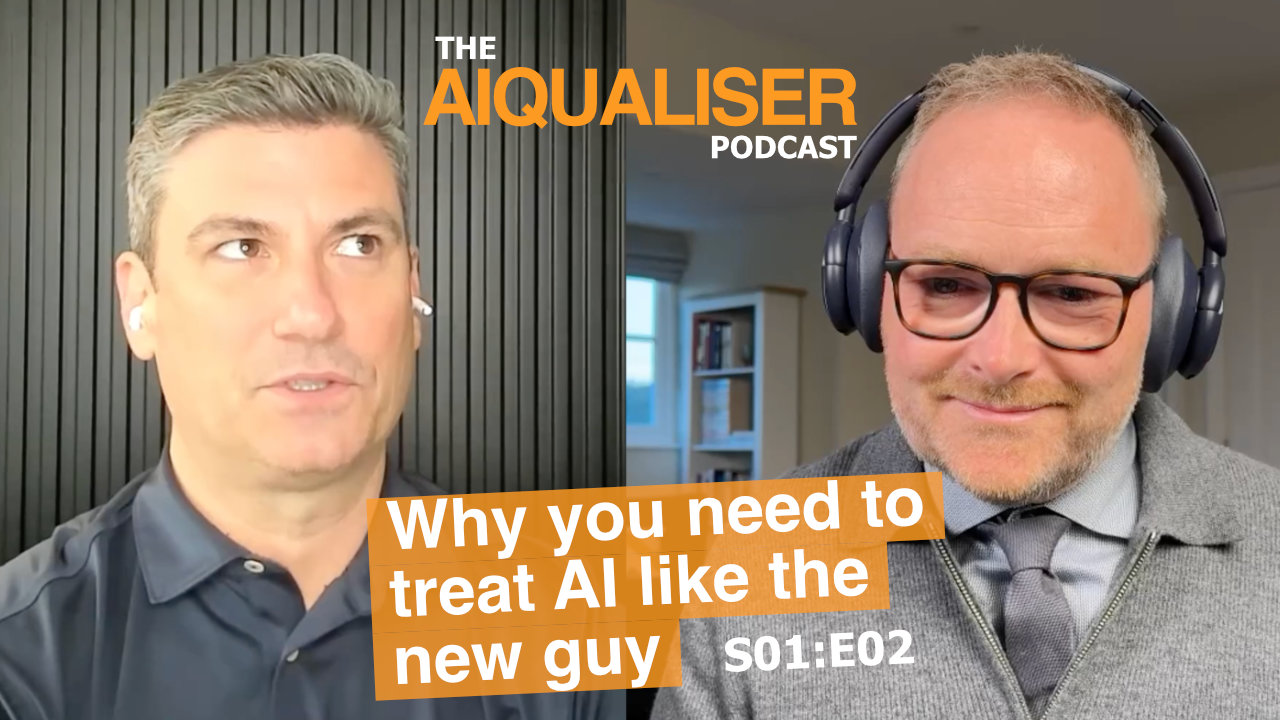
In this episode of The AIQUALISER Podcast, John Bennett talks with Russ Henneberry, co-author of Digital Marketing for Dummies, about why AI often frustrates us, and why structure and judgement matter more than prompts, tools, or model choice.
Russ reflects on a career shaped by repeated reinvention, from early internet marketing through to content, SEO, and platform shifts such as Google, Facebook, and now AI. He positions AI not as a creative shortcut or a mysterious intelligence, but as a general-purpose system that behaves predictably once its true nature and limits are understood.
A central idea in the conversation is the “new guy” analogy. When AI delivers generic, bloated, or inconsistent outputs, it is usually because it lacks context. Russ explains that most frustration with AI comes from treating it as if it already knows the job, rather than recognising that it needs onboarding just like any new team member.
The discussion moves on to why clever prompting rarely compensates for weak intent, unclear scope, or missing structure, and why letting AI run in auto mode can quietly undermine human thinking. AI will almost always overproduce, and the real work happens in editing, cutting back, and deciding what matters.
Russ also cautions against constantly switching tools in search of better results. Staying with a small number of systems allows understanding to build properly, while novelty keeps attention scattered.
To find out more about Russ, visit theClick.
In This Episode
Why AI often feels inconsistent or disappointing
The “new guy” analogy, and what it explains about generic outputs
Why structure matters more than prompts or model choice
How auto mode can trade speed for judgement
Why AI overproduces, and why editing is the human job
The risks of tool hopping versus going deep with a few systems
Why responsibility and authorship do not disappear as AI improves
https://youtu.be/S3CDSgcBmvc
Transcript
John Bennett (00:18)
So welcome to The AIQUALISER Podcast where we try and balance out the AI noise with conversations about how people are really using it.
for me, the first self-improvement books that I bought were the For Dummies books. They kind of came out in 1991 when I left school and started my entrepreneurial career for real. So I'm really excited to be talking today to somebody who literally wrote the book on digital marketing, Russ Henneberry, who was the co-author of Digital Marketing for Dummies. So welcome, Russ.
Russ Henneberry (00:46)
Hey, great to be here, John.
John Bennett (00:48)
So as I say, for me, that's really exciting, the For Dummies book, but I know that you've done a lot of other stuff and one of things that you talk about is reinvention. You've seen a lot of things come and go and you've had to reinvent a number of times to, if you like, take advantage of those or be in the place of those. So maybe just give us some background.
Russ Henneberry (01:09)
Well, I started out as an educator. my college degree is actually in secondary education, social studies, history. Taught school for four years, actually, in my first career. And then jumped out of that and started a company right when the internet was becoming a real thing. Like I'd say 2003, 2004, when the internet was
you know, and I built my first website and did all this stuff and ⁓ I started a company doing fundraising for schools because I knew schools so ⁓ you know I built my first website I started to figure out a little bit about SEO like why you know there were search engines at that time and you know we were just all trying to kind of figure it out we were writing blog posts and you know I was following
OG digital marketers like Brian Clark, copy blogger, Chris Brogan, and Darren Rouse, and some of these early folks that some of you may not even know who these folks are, but they were sort of the early digital marketers. called them internet marketers back then, ⁓ yeah, I fell in love with digital marketing. That first business was a massive failure. I could never get it going, but I found my passion.
and that was digital marketing. And I took that experience and you know, various times I worked for companies, I worked for in the corporate world for Network Solutions, which was the first company that was allowed to register domain names here in the United States. I worked in their SEO department, managing, I don't know, we had three, four thousand.
clients at any one time. We dozens and dozens of people working on search engine optimisation and then we had a PPC department that bought ads and web design department and ⁓ kind of got the idea of what it looks like to try to scale digital marketing up to where you're managing thousands of accounts and stuff like that. Spoiler alert, that's really hard to do ⁓ to manage that client load. ⁓
And then went to work for Salesforce.com, ⁓ did content marketing for them, helped them launch blog.salesforce.com and a ton of experience there. From there, John, there was when I learned about how to justify content and digital marketing in terms of its ROI. Salesforce really cares about ROI. Where are the sales coming from? Why are we paying you guys to write
articles on blog on so sort of a master's degree in in business metrics from Salesforce My last real job in between these times I would kind of always go out and pick up clients and do all these things my last real gig I would say was in 2013 to 2017 I worked for digitalmarketer.com Ryan Dice and his company
And we grew that company. I was really proud of that. I was in charge of content marketing and product there because we built a lot of courses. you know, so my experience as a teacher actually served, has served me really well in my career. But I would consider myself, you know, a generalist in the area of
digital marketing, I was interested in everything, ads, content, copywriting, analytics and data. But if I really zeroed in, it would be on content marketing. That's where I was ⁓ in the digital marketing world. That's where I'm, you know, my...
⁓ sort of mile deep goes right on on content and SEO and search and Social and that kind of stuff
and
when AI came around I was like, whoa this thing can write this thing can create and of course now, you know, so that was November 2022 ⁓
you know, basically immediately recognised like, wow, this is a game changing technology. Like this is crazy. And so I was like, I really need to learn this. You talk about reinvention. I think it's a, you know, it's one of these things that takes courage, I think to, ⁓ you know, maybe naivety that you could just go and learn something and,
and pivot like that, but I don't know, I've always been the sort of person that gets curious about something and maybe even unintentionally starts to reinvent because ⁓ I just love these tools. ⁓ I mean, I know there's downsides to them that we can talk about socially, morally, ethically, all of that stuff, it's certainly there, but from a business perspective,
I really get these tools, I don't know why, but just, from a interaction with computer standpoint, I just really sort of fell into it and was like, wow, I just kind of understand how these tools work.
So I launched the click in 2019 actually as a newsletter about digital marketing and have slowly morphed that into, you know, it's very AI forward and it's sort of a combination of digital marketing and AI.
John Bennett (06:58)
Yeah, so I mean, it sounds like you got into AI right from the start, because it's a question I like to ask, you know, When did you realize that AI was going to be something useful? from what you're saying, as it came out, you were kind of on, you were like, wow, this is something I need to take notice of.
Russ Henneberry (07:17)
Yeah, mean, I would love to go back in my LinkedIn because early in 2023, pretty, you know, a few months after ChatGPT had their moment and then, you know, now Google was on the scene with, at the time it was Baird think, was that what it was called? The earliest version of Google's AI answer to ChatGPT and...
I started to think about like, wait a minute. And I ran a poll on LinkedIn that said, how often do you ask an AI a question that you used to ask Google or a search engine? And at that time, early 2023, almost nobody, there was four answers to that, was rarely, sometimes, so sort of like graduated up.
And almost everybody was in the never, I've never done that, or rarely stage of that. And I just knew, and so I started running this poll every three months. I would put the same poll out, same question, and slowly you started to see people starting to answer that, okay, I do it rarely now, or I do it often, or I do it almost always. And so I saw...
I guess not, not AI as a creation engine, as much as I saw how it's going to impact the consumer and how people are going to find information, how people are going to interact with computers. You know, that change is already now well underway. We all know that. ⁓ but I don't know. saw it, I saw it pretty early and I wrote a, I wrote an article, ⁓ that was basically comparing like,
the experience between Googling something and sort of hunting around through a bunch of links and seeing a bunch of ads and, you know, pop-ups and, you know, can't find this, can't find that. And then the experience of just asking an AI the same question and just getting a response back, right? And being able to follow up that response. it's just, it was just so starkly clear that this is where this is going to go. And
So more interesting to me has been than the ability for AI to ever create anything, even though that's fascinating as well, is the disruption in how people are interacting with machines and just doing what we always do, solving problems, ⁓ being entertained, being inspired.
educating ourselves, making informed buying decisions. you know, people are using AI for all those purposes.
John Bennett (10:12)
are the things that AI does that still surprise you?
Russ Henneberry (10:15)
Every day, yeah, every day. Anybody that thinks they can predict what this is gonna look like, I think even three years from now, I think it's doable to sort of project out a year and say, okay, I can see sort of where these are going. If you use the tools a lot and you're paying attention to labs and what they're talking about and.
that kind of thing, can kind of see where this is gonna be in a year. In three years, I just don't know that we can see, and certainly not in five, like it's just so fuzzy as to what it will look like in three to five, certainly 10 years, it's just like, all bets are off, like you have no idea what anything's gonna look like in 10 years. But.
In the next year, you can kind of see, well, everything's gonna get a little smarter, a lot of the buggy things about this are gonna go away. But then occasionally, you just see something and you're just like, ⁓ I didn't even see that one coming. I didn't anticipate that. And there's usually small examples of things that it's just like, okay, that's new. So for example,
When ChatGPT5 came out, I had been anticipating that for a long time and thought, this is going to be a big change. Like, they're going to probably blow up the whole interface, maybe. And ChatGPT5 will be a leap, like 3.5 was to 4.
It wasn't like that from an intelligence standpoint from a capability standpoint, the AI didn't get that much better when ChatGPT5 came out and it was sort of a, don't know if you remember this, but it was sort of a letdown when it was like, oh, that's five. Like that's ChatGPT5? And then 5.1 came out and it was sort of a more of the same. And don't really remember a hundred percent like how to characterise 5.1, but 5.2. So which is out now.
at the time we're recording this is what ChatGPT5 should have probably been they may have rushed to get that out ⁓ because 5.2 can you know the other day i was working on something and I gave it quite an ambitious task and it worked for eight and a half minutes and I just sat there and watched it working because you can kind of open this little carrot tab in there now and watch it's
behaviours and it sort of gives you some insight as to what it's thinking about as it goes. It's become way more agentic. You know, I've never seen ChatGPT like work for that long, right, on something. You know, that's one of the curious things is like everybody talks about speed when it comes to AI, but what's...
at least equally as interesting is AI that works for long time horizons, you know? And that's what we're starting to see with these tools is this thing can work for, you know, Claude Opus. And when I use AI to code, for example, I have no idea how to code, John. Like no clue, Like I'm not a coder, I'm not a developer, but I can build little applications and stuff like that as you've probably played with as well.
John Bennett (13:37)
You
Russ Henneberry (13:45)
And you'll watch an AI go and work for 20 minutes on something. And you go eat lunch or something, and go for a walk, and come back, and it's finishing up. So AIs with long time horizons and what they're capable of doing with the right set of instruction.
and their ability to sort of like go through something and then make a decision about, know, based on the prior, so you tell it to do something, it goes and does something and then based on what it does in this first step, that informs the next step. That is agentic behavior and we're already seeing it just in regular old $20 a month chat GPT 5.2 is able to sort of make decisions on the fly.
based on where it wants to go. And that's surprising to me that we're already at this point.
John Bennett (14:42)
What if somebody's just starting out and they've not used AI yet and, you know, they're new to this, what would you suggest that, like they do first to try and...
you have that, they've got the curiosity but where should they direct it and how should they take the first steps?
Russ Henneberry (15:01)
If you're using ChachiPT for work, which it wasn't necessarily built for you to do work inside of it. It wasn't necessarily built for you to do science or math or, you know, research recipes for dinner or it wasn't necessarily, it's not, it's a general purpose technology, sort of like electricity, right? Where, you know, electricity wasn't necessarily built to do this or that, but now it's just sort of here and the applications of it are everywhere.
kind of don't even notice that it's here. But if you're trying to use it for a very specific purpose, which is to do work, right? And maybe grow a business or grow somebody else's business that you work for or work on. We need to think about it in terms of
this, and I hate to anthropomorphise AI because I don't, there's nothing about it when you really dive deep into it that is necessarily human. But it does behave very similar to a human intelligence. And so if we walk through this sort of idea of, you you think about If you brought on a new hire at your company and you brought this new person in,
This person might be very smart, very capable person, but on day one, when you first bring them into the office or whatever, they don't know anything. Like they, they may not even know what you sell. They may not know who you serve. They may not, they don't know all the past projects you've been working on.
They don't have any of that context. And so that's why the new guy at the job is sort of the new guy. It's like, oh, okay, new guy, you know, and he's sitting in the meeting and, you know, he's just trying to sort of soak up what's going on in the office. What's going on with this company? Who do we serve? What do we sell? What are we doing? And your AI is very similar to that. In fact, it's tremendously capable, right? Has insane levels of knowledge.
And now, as things have evolved, it's got all of these capabilities to create things and organize things and summarise things for you and do so much work for you, help you think through things, right? It can be a very good thought partner. But the problem is when you go to use an AI and you don't structure it properly, like you don't sort of put some kind of structure in place,
then it's a new guy. Right? It's just every time you start using it, it's the new guy. It's like, I don't know, like what the heck are you working on? Like, who are you? Like, ⁓
Because again, because it's a general purpose technology, it has no idea what you're gonna talk to it about. Like you go and you start to type in there, you could type anything in there. You could ask it to build you a workout routine. You could ask it to talk to you about what's coming up with the NFL playoffs this weekend or whatever, right? Like it doesn't have any idea. And so what we have to do is structure the AI in a way that...
You know if you want to again anthropomorphise it and turn it into a person like you want to train it right you want to sort of give it an idea of This is what we do around here This is who we serve and you want to store that inside of the AI in a persistent manner so that it's always there just like you know after the new guy's been there for six months
and he comes back into work, he's got all this stored knowledge, right? He knows like all the projects we've been working on. He knows who we serve. Like he's got a much better idea and is much more valuable to the company after six months, hopefully, and has learned the ropes a little bit. And after a year and after two years, like this person becomes, I used to tell my son all the time, because he works in the restaurant industry and so did I when I was going through college and stuff. I said, never stay at a restaurant. I said, I said,
At some point you will become the guy who knows everything. Like you know where everything is, you know how every process works in the restaurant, but you're not getting paid anymore than anybody else. It's simply because you've been there for three years or four years and it's like, I don't know, ask Russ, you know, he's been here forever. And the same thing happens with your AI.
is start to think about it like it is deceptively simple to use, isn't it John? Like when you go to chatgpt.com literally on the page right now it says, what are you working on? Ask me anything. Okay, so it looks like, well, there we go. And if I start to type in there, it's gonna answer me and it's gonna start doing the thing. But when it's not structured properly for work, it...
you know, what you get back is often just like generic bland boiled chicken. And it's no wonder why you get that back because it's a new guy. It doesn't know what you do. It doesn't know what you sell. It doesn't know what projects you're working on. So my advice to people that are getting started is, and most people that are quote unquote getting started have probably played with these tools and maybe have come away a little unimpressed or, uh,
frustrated at times. The AI does all kinds of wacky stuff. It hallucinates, it forgets things, it goes off the rails, it turns back completely rational responses that are kind of useless because it's like, well, that's just the most generic answer I could have ever got. So.
If you're really going to use it for work, think you need to invest in thinking about and putting in a little bit of time, energy, money, whatever it takes to learn how to actually use the tools. Like, and that means structuring the AI in a way that it's not a new guy anymore. Does that make sense? Did that analogy work?
John Bennett (21:05)
It does. I love it. I
love it because when you start to use it, it's amazing, the stuff that you get out of it. And I think maybe that's the gap. Maybe because it seems so intelligent, maybe we're just not realising it is the new guy. so I totally love your new guy analogy because if we bear that in mind when we start to use it, we go, okay, okay, well, this may be really capable, but it's day one.
they don't understand or it doesn't understand or the machine doesn't understand anything about me, anything about my business or the project I'm working on so I love it, I totally love the new guy, I think that's...
Russ Henneberry (21:45)
Yeah. And I think
the thing to point out here is that you don't have to wait six, 12, three years for it to become not the new guy. You just need to structure it. It would be the difference. You've, you know, I bet you everybody listening to this or whatever. You've had jobs where you came in to the job and they had a good onboarding process. So they may be putting you through a good training. And my guess is that you became extremely valuable much quicker.
Right, because they had a good onboarding process. Like they brought you through and they were like, okay, like here's what we sell, here's what your job is, here's what you're gonna do. And other companies you go to work for, they're just like, well there's your desk, like figure it out. Like this is your new job, right? And so much longer to ever catch up and get up to speed and become valuable to the company.
And the same thing is true here. Your AI can become your most valuable business consultant and worker on day one if it's structured right. You can just start it that way. In fact, when people join theClick and they start to go through my training, a lot of times I tell them, completely purge your chat GPT account, which is...
You know, like some people like purge it and I'm like, yeah, if you want it, I'm not telling you what to do, but I, one of the nice things you can do is just start over and structure it this way and watch how much better it gets. So I've at two different times, I've completely erased my ChatGPT account and started it from, from the beginning to restructure it.
And ultimately ended up with this Growth OS process that we teach it at theClick, which is how to structure ChatGPT in a way that it can do work so that it's not the new guy on day one. It's a five-year veteran on day one.
John Bennett (23:43)
If we can make AI go from new guy to the most valuable team member in the day or in a very short time, people have a lot of worry, don't they, about AI replacing them. So what would you say to people that have that fear?
Russ Henneberry (24:04)
I wrote about this the other day. So there's this concept in AI called Jevons Paradox. allow me to, some of you probably heard of it, some of you maybe haven't. So Jevons Paradox, this idea that anytime in the past that we've had a technological breakthrough, it's not reduced the amount of available work, it's increased it, like exponentially. So for example, let's go back to that electricity example.
You create electricity, a completely game changing technology, hard to kind of put our heads into a place where there was no electricity and then all of sudden it's like, well, what is this?
And it didn't eliminate job, I it did eliminate total departments of jobs. Like there's entire things that just phased out. It's like, we don't need candle, this many candle makers anymore, for example. But in the end, it created this entire productivity boom around it that created tremendous amounts of jobs and productivity and things to do using the
this new technology. Same with computing, So computing, people are like, well, are we gonna need accountants anymore or are we gonna need, know, any of these people are computing. And all that did was lead to a productivity boom. So you look at how...
sort of the world gross domestic, like world GDP, you know, it just always goes up in this upward trend no matter, and you can see these sort of like spikes that happen because of major technological breakthroughs. So the AI optimist will say, Jevons Paradox, like it always.
comes out this way that any technological breakthrough will not lead to less work, it leads to more work. the critics of that will say, well, yeah, but we're not talking about electricity, we're talking about coworkers. talking about, we're talking about.
Technology that does what we do like we didn't You know electricity wasn't that way computing wasn't that way like we don't we didn't do those things this thinks this rationalizes this this can mimic it can mimic things like empathy and Emotion it doesn't have emotion doesn't have empathy, but it mimics it so it could conceivably be a therapist or a doctor and bring
not just the knowledge of medicine or psychology or whatever, but also the bedside manner, maybe even in a better way than a doctor would, because the AI just never has a bad day. It's always, if you want it to be, it can always be positive and chipper and polite and all of those things.
So I don't know what to tell you on this one, John. I'm not gonna sugar coat it. I think, again, we can kind of foresee what's gonna be happening over the next year. And I can give you a prediction there, but in terms of three, five, 10 years out, I don't know what this looks like.
because when this stuff first launched, there was a lot of people that were like, well, I don't use, I don't use AI. Like I'm a purist. Like I don't, I'm not using it. Sort of like it was some kind of performance enhancing drug that you don't want to get caught with in the Tour de France. You know I mean? Like, so like, ⁓
Instead, what we're seeing now is people are saying, I do use it. I do understand it. I am learning it. am. And I think that's what I mean. There's just no question. Every survey of a CMO or founders are like, there is a gap out there of there's people that know how to use these tools and there's people that absolutely don't. And we need more people that do understand these tools.
My advice for people clearly is learn this technology and don't just learn it at the surface level. Get training. Actually learn how to use the tools because imagine a accountant that says they won't use spreadsheets or Excel or something. It just doesn't make any sense that we wouldn't use these tools. ⁓
You know, ⁓ my advice to people is to invest in learning these tools and not just at the surface level, but learn them deeply and understand how they apply to business and actually executing work.
John Bennett (28:51)
I think right at the start you mentioned curiosity. you know, being curious and thinking about how they work and trying to understand them. But as you say, you know, I think that I always say that there are, there's three approaches to AI. There's the one you just talked about, the head in the sand. You know, I'm going to put my head in the sand and I'm hoping when I pull it back out, this thing's gone away, which.
I think we're seeing now it's not going away, it's here to stay. There's the use it on the surface or mindlessly accept what it gives you or there's, as you say, this kind of get under the hood. What is it good at? What actually is it? How does it work? And how can I bring my skills to bear? So how would you kind of work on that? How would you suggest people try and understand what it is and...
what it can do and what they can bring on top of that.
Russ Henneberry (29:45)
Well, I mean, you know, when I first got started in learning, there was there was not a lot of people publishing about it. Like a lot of people, the initial reaction in early 2023 was just one of. panic a little bit, So most of the content that we were seeing was around the morality of it, the ethics of it.
But you know, I was starting to think like, where's the information about like actually how to use these tools? So I was fortunate in 2003, 2004 when I was coming out of that first business venture that I mentioned at the beginning, Google was becoming the household name. So I started hearing my mom say the word Google in the early 2000s.
And so was like fortunate to be standing right there in the very early part of, very beginning of my digital marketing career when Google was becoming this mega platform, what I would call the first mega digital platform where, you know, it started out, it was a search engine or whatever, but like, I mean, think about what Google is today. It's a massive platform that's difficult to pin down exactly what it does, you know, when you look at all of its assets.
And I remember thinking like, I'm gonna learn this tool. Like I am gonna learn Google. Like I don't wanna know a little bit about Google. I wanna know everything there is to know about Google. And at that time, I didn't tell this part of the story at the front, but when my business was sort of floundering around, I had made a partnership with a guy who sold trade books to schools.
And he just said, well, you're doing all this stuff for your company, but he's like, how's it going? And I was like, not so good. I just had a kid. I'm kind of freaking out. I'm gonna be health insurance. He's like, come work for me. And I said, well, I'll come work for you if you put me through MBA school. So we made that agreement. And you know,
It was there that he came to me and he said, why are we not showing up in Google? Like why is our competitor showing up in Google and not us? And I said, well, I don't know. And he said, I want you to go find out. I want you to figure that out. I want you to get everywhere down in there and figure out why that's happening. And I realised right then that there was so much value. Like this guy who owned this company, you know, maybe we were doing like,
I don't know, 50 million or something in trade books to schools. So a decent sized company. And he was really interested in why this little platform was not showing up his thing. And the more I got into it, the more I was like, holy cow, like there's a whole world underneath here.
Because Google is exactly at that time and still today was exactly as chat GPT was. You would go to Google and there'd just be this white screen and a box. And it'd just be like, ask me anything. Just like chat GPT is today. And 99.999 % of people just use Google. Like they would just use it. They would just go in and type in whatever they wanted. You know, I want to get some Thai food or I want to.
You know, like you type it into Google and you just move on with your life and you just it just works Then there was a small percentage of us that learned under the hood How does this thing work? Like I want to know deeply why does it work this way? Why does it work that way? You sort of create this industry around search right and how Google works basically and the funny thing is it wasn't I left that company and that's when I went to work for Network Solutions in the SEO world
And two and a half, three years later, I saw my old boss, who owned that book company in New York City at the Javits Center, you know, big convention center. On the one side of the Javits Center, they had the book expo and he was speaking there. I walked past, he's in the Starbucks line and I said, hey, Neil. He's like, what are you doing here? And I was like, I'm here to talk about Google on stage.
at this other digital marketing conference over here. So in two and a half years, I became one of the people that knew Google, like really understood the business impact of Google. How does it work? How do you make this do that? And how do you make that do that? And so the same thing's happening now with AI, right? And actually there's multiple platforms in between there. There was 2007, I watched so many people, not just
understand Amazon, but really learn Amazon. Like really get in there because Amazon became this thing. It was just like everybody, everybody. And it was just massive value in Google in early 2000s, then Amazon, then Facebook, my friend Molly Pittman, who I've been working with for 13, 14 years. She was standing there in her early twenties and
here comes Facebook advertising and everybody was like taking candy from a baby on Facebook. It was so cheap by leads and by sales. She didn't just use Facebook like and just be like, well, I learned how to post on it and I learned how to do that. But yeah, it's like everybody else. She learned Facebook. She learned the ad platform. She got underneath the hood. She figured out how does it work? What works on here? What doesn't and found her, you know,
She's still doing that. Like it's 2026. She's still doing that. We are at the fourth platform we had Google, Amazon, Facebook, chat GPT or AI. Let's just call it. Who knows who's going to win and who's going end up being the MySpace of AI. But we have AI here. I would say, you know, most people are using chat GPT. Learn it. Really learn it. Don't just learn.
surface level like how to prompt, how to write prompts and stuff like that. Learn deeply how it works because there's so much value and every business owner out there is trying to figure out how can I use this? Just like my old boss, Neil, when he came to my desk and he said, why are we not showing up in Google? They are asking the same questions about AI and you're standing right here at the forefront of that, right? You're at the beginning of it.
This isn't something that is, you could decide to learn it at the surface level or you can decide to go a mile deep on this and really learn these tools. And there's so much more, just like there was with Google, Facebook, Amazon, there's so much more under the hood that you could learn. And it does come back to curiosity. John, that's one of the things I appreciate about you too. You're in my community and you're one of the most curious people in there. Like
always toying around with this and playing with that and finding new cool use cases to use it for work. And that's valuable.
John Bennett (37:05)
Yeah, I think it's a great takeaway, it? you know, if you're scared of it, and you're worried that it might take your job, then face it head on and learn everything about it. Jump into it and get under the hood.
Russ Henneberry (37:18)
I remember doing that originally and finding it far less scary after I got under the hood. I was like, ⁓ there's a little bit of a wizard behind the curtain going on here. If you remember, you know, that effect where it's like, there's no, there's no spooky sentient being under here. It's brilliant engineering that makes AI work.
John Bennett (37:41)
That's an interesting take, isn't it? Because you're taking away the fear there by understanding what it is. I like that. I really want talk to you about the community because for me that's another thing. So I'd love to talk about theClick a little bit. But before we do, just that idea of community because again, I think if you're worried about it, talking to people and...
getting people's read or people's feedback and learning from other people is probably a great place to start. So one of things I love about what you've done is yes, you teach through the courses, but you've really fostered that sense of community of people that bring things to it and chat. maybe just tell us a little bit about theClick.
Russ Henneberry (38:24)
Yeah, so my take is that everything that's ever happened to me career wise that was an exponential jump came from being connected to other people rather than, so I believe you need to be doing three things to keep advancing your career. The first one is gaining skills.
The second one is gaining experience. And so you combine those two, those two, right? You learn new things and then you go play. So for example, with AI, if you came into theClick and you started to do some of my trainings and so forth, ⁓ it's great because you're looking at that and you're gaining new skills and new knowledge.
But then you want to take that and actually do something with it. Right? Get experience. I always call this like creating a sandbox. Like even if you don't have your own company or anything just yet.
still go and play with the tools, like do the exercises that we do, and that gets you that skills and experience. And skills and experience for me have always been incremental gains in my career. Like, just slowly ticking up as I either stay abreast of what's going on with, and learning new skills, or just keeping my skills sharp, or getting more experience. All of that's sort of like this upward trend in terms of like,
my earning power, like the amount of money I'm able to earn. But it's always been that third layer. So you have skills, you have experience. The third layer is connections. And it's the people that you know and that you connect with that will always end up being the exponential gain in your career. Like every major jump that I can remember, including being able to write digital marketing for dummies and every other
big jump type thing for me that unlocked new doors and so forth came because I knew somebody else. Like me and somebody else partnered up on something or this person told this person about that and then, you And so being a part of communities is really crucial and building community around what you're doing. know, like getting to know other people is...
This is the type of stuff that leads to not only exponential gains, which is awesome about it, right? Like you make these big jumps, but it also just makes work so much more fun, right? When you're a part of something. A lot of us work, I know I do, at home and maybe don't see anybody but our cat all day. I don't actually have a cat I have a dog, but you get what I'm saying. So,
we, you know, at theClick we create these online meetings where we jump on and we share ideas. Yesterday we were on there talking about Notebook LM from Google and some different cool stuff that Michael Longfellow is doing with Notebook LM.
You know, what I love about that is that, you know, I can't, I can't personally possibly keep up with everything that's going on. And so a lot of the members are coming in with cool stuff like you, you came in and, did a whole, training on how you wrote your book and, and, and, the things you learned that you would do again and things, how you might do it differently. That kind of stuff's priceless. but on top of it, it's just, you know, been good getting to know you right. And, and, and, and,
you know, you're working on and, you know, doing stuff like this. So I think that the community aspect of theClick is as important as the actual skills and experience that we gain by staying up with what's going on with AI.
John Bennett (41:59)
I think there's a real takeaway there as well, there? I mean, I would advise anybody to join theClick. But if they didn't, I think still that idea of you build a community. so again, if you you're worried about AI, you're trying to learn about AI, you know, who can you talk to? There must be somebody that you know, that is trying it as well. And you can compare notes. Google notebook LM.
I was late to the party, only found out about it, I think about three months ago, and it blew my mind. This tool that you can put sources into and you can chat to those sources, make your podcast or an infographic that you can just take away. For me, it was a game changer. And again, I hadn't heard of that.
for about 14 months after it launched. And yet I work in the AI space and that thing, you say that, you're talking to other people and they go, well, have you tried this tool or have you seen this thing? Or I think there's so much value in that kind of human connection.
Russ Henneberry (42:54)
Well, one of the things that brings up in my brain is something I've been talking about lately, is, you know, when I, I told you, when I came out, I was trained as a social studies teacher. I studied a lot of history. And when people hear that, say, yeah, well, what year did the, you know, attack on Fort Sumter happen in this place? And I'm like, well, just because I study history and I was a history major doesn't mean that.
I know every dang thing about history. In fact, I specialised in world history and I still don't know nearly everything to know about that. And AI is the same way. Digital marketing is the same way, right? It's a massive category, right? So you kind of got to think about it in terms of...
Where do I want to settle in? Like where, so for most of us, probably that are listening to this call, you just want to use it to do better work, maybe grow a business, launch business, and so on. So I think it's important to figure out where am I going to draw my scope in terms of what am I going to pay attention to in the AI space. That's been a challenging thing for me because I am
tremendously curious so I can end up going wide and it is part of my job same as you right to sort of stay up on a lot of different things, but if I'm talking to somebody who You're really got your own company or you work for a company. Just looking for it to do work. I I think it's 2026 is a good time to select a tool and learn it deeply and structure it properly in other words put things inside of it
as we talk about in theClick, put things inside of it that turn it from new guy into your veteran advisor and worker. And then only switch tools when there's a good business reason to do so. You see, okay, this tool is clearly better and I'm willing to make the switch.
There's a switching cost, right?
Doesn't mean you shouldn't be tinkering around and sort of paying attention to other things, but I do see people sort of like hopping all the time. And I think that's a mistake because the AI gets better the more...
you train it and the more time you spend with it, it gets smarter. And that will continue to be the case. Eventually being a situation where it'll be like as big of a switching cost as switching cell phone providers, which is like, you know, not easy to do. I've been with the same cell phone provider for 20 years, John.
John Bennett (45:42)
glad you brought this topic up because it's one of the ones I had on my list to talk to you about because there is so much noise, isn't there? So many new tools coming out and then this one does this and this one does this. It's hard sometimes to ignore and it's also overwhelming at times. You think, well, hold on, are we using this tool? Would that tool be better? And I think the way you describe it just there was great, which is keep an open eye.
keep an open mind as to is something genuinely better than what you're using now but at the same time accept that you're using a tool and you've developed it and you've made it not the new guy so you know have some patience
So one of things that we like to do, Russ, is to take a listener question and discuss it. And of course, we're quite new, so we don't have a bank of these. But also, the question that we were discussing last episode is, I think, such a...
such a big question that I'd really like to get your take on it. So the question that we had in was from Ben and Ben asked, you know, how would you structure a complex prompt to do to work on a business plan? And
my guest last episode, Dr. Dan Maggs we discussed that and Dan was saying, look, this is beyond a prompt This is, you know you need to build some context around this. And of course, a lot of that is exactly what you teach in theClick. But I'd love to get your take on how you would approach building a business plan with AI.
Russ Henneberry (47:13)
Let's go back to the new guy, veteran guy scenario. So if you were gonna do business planning, which a lot of us have done in the past, you get some brains into a conference room and you get a whiteboard and you get some slides maybe and you go about planning a business or making a Q1 plan or marketing plan or whatever it is. So why are we gathering
people and how do we choose the people that come in the room? Well, we're not going to bring the new guy in there unless we just want them to be a fly on the wall. Like, you just sit over there and absorb what's going on. So the first step is we don't want to be doing marketing planning using AI when we have a new guy AI. So we want to make sure that there's context persistently added into the AI. Those most fundamental, there are two documents that are most fundamental.
when you're doing that. And the first one is what do you sell? So literally just a PDF document that describes your product or service in as much detail as you want, but even one sentence would be better than it. One sentence would be a hundred times better than zero information about what you sell. Like even one clear sentence, I sell shoes. Think about that. Right.
If you want to use a world-class intelligence, it's incredibly knowledgeable, incredibly capable, and you want to ask it to help you build a marketing plan, telling it that you sell shoes versus giving it zero information is going to be quite the difference in outcome. But even then, a little bit more detail would be even better. Now, there is an upper limit to this.
Typically the documents that we build that describe what we sell are maybe a page long, maybe two pages of copy. It doesn't need to be pretty. It doesn't need to be just format it in a way that is very clear, right? Using bullets and headings and stuff like that. Give the AI that document, like attach it to its brain by uploading it inside the thread would be the most basic way to do it.
But then we talk about more advanced ways to do that. That's part of what I mean when I say structuring your AI properly so that it always knows what you sell. Like every time you turn it on, it's like, yeah, I know what you sell. The second document, so the first document's the offer. What do you sell? What's your product? What's your service? Just describe it. Maybe the pricing, maybe the guarantee, maybe some information about, you know.
Whatever you would want somebody to know before they did a business plan with you, the second document would be who do you serve? What persona or ICP, some people call it, ideal customer profile. And that can be one sentence if you want, right? We serve athletes. So.
one document says, I sell shoes. The second document says, we serve athletes. Feeding it those two bits of information, your marketing plan already just got 100 times better. But again, more depth about who you serve, and particularly, John, the pain, the challenges of that person. So.
If you feed the AI some information to make it so it's not the new guy, the first two pieces of information you want to give it is what do you sell and who do you sell to? Then from there, it's still not a prompt.
I mean, you could design a prompt to probably write a business plan. It's definitely today in one shot. You know, you could give it this big long prompt like this, all the stuff I want in here. and it's just like a big
description about what you want in this marketing plan. If it has enough context, it would probably do a pretty serviceable job of building your marketing plan.
That's not typically how we work, right? Like the way I work, I don't know about you, but like a lot of times I just want to start a conversation with the AI, right? Like I just want to, I start with an AI that's not a new guy, right? The more context I've fed it in terms of like what we do. Maybe I'm working with the veteran, the five year veteran or whatever. And I might just start with a conversation. Like, let's think about, you know,
what we're trying to do here. Like I'm starting to build a marketing plan. You can even ask things like, what do you think the components of this marketing plan should be? That's a good way to start is to work towards whether you have a structure in mind of your own or whether you want to have the AI help you build out that structure. A smart thing to do is to first create the sort of bones of what you're going to want.
right? And then add the skin along the later. like, you know, the way I would start out with this, if I had no, you know, preconceived notion as to how I want this, marketing plan to be set up or structured would be to say, Hey, you know, we're working on a marketing plan. What do you think the components of that marketing plan should be and let it sort of start out by listing on, well, a good marketing plan. And it'll take into account if you structured it, right,
that you're selling this and you're serving this person, right? So it's gonna take all of that context in mind and say, well here's 15 components of the marketing plan that I think we need to put together. Now, my guess is you're gonna need to remove some of those. So most of the output that you get from an AI, you're gonna need to give it a haircut, right? Like you're gonna actually cut down, which is actually, think a good thing, right? Like it could give you too much. And you say, well, here's the eight pieces that I wanna make sure in our plan.
and you feed it back into that. I think we need to do these eight pieces. Let's start with this first piece. What do we need to be thinking about when it comes to this first piece? And so it's really more of a organic conversation in that way than building some big fancy prompt like we were led to believe in in 2023, 2024. I think we're getting away from that now, I hope.
There's so many people out there that want you to think that they have some magic prompt when in reality it's just literally it's not required. And a lot of times it's counterproductive, you know, to use some, some boilerplate, marketing plan prompt or anything else.
John Bennett (53:53)
It's one of my frustrations when you see all these things where, this is the ideal prompt for this thing or that thing. As you know from my book, one of the main things is you have to start with human intent. And I just worry that...
if you're using somebody else's prompt, you can't get your human intent right. you you need to, if you do want to use it, you need to have a look at it you go, okay, what is it trying to achieve? And what am I trying to achieve? And what would I change? One of the things I've really liked, well, two things I really liked that you said there, one was this.
Russ Henneberry (54:07)
Yeah.
John Bennett (54:22)
It's sort of like an iterative conversation. So, you know, we're not trying to get this prompt that we'll do it in one shot. We're going to go into a dialogue and into a conversation and we're going to build that over some back and forth. The other thing I really like that you said there was this idea of cutting back, you know.
I think there's a temptation when the AI gives you something to go, you know, this is what I need. And maybe tweak it, but actually, I think you call it giving it a haircut is a great idea because it's probably going to give you more than you need. And actually sometimes less is more maybe.
Russ Henneberry (54:56)
Yeah, it does take some experience working with it where you're just like, wait a minute, you know what, you're just giving me way too much. You gotta understand, this AI's probably read 150,000 marketing plans or something, right? It's looked at.
and read through a gazillion marketing plans. It knows what could or maybe would be included in a marketing plan. It knows what could or would be included in a marketing plan for a business that sells shoes to athletes. Like it knows that. And it's gonna err on the side usually of being extremely thorough about everything that you could possibly include in there. And so.
you know, lot of our role as humans in the loop here is I love what you said there, which is to bring our intent, like what is it that we're trying to do and using that AI as a thought partner. But we have to be the ones that ultimately decide like, you know, this, this component should remain. And honestly, most of the time, you know, the AI, when I'm using it as a thought partner in this way,
Most of the time, or a lot of the time, I say most of the time, a lot of the time it just sparks a different direction for me. Like I read some and I say, yeah, that's good. Just like you would when you and I are talking, John. Like you probably feel that too where it's just like I say something.
and it sparks something in your brain and you say, I really like how you said that because let me just put that there And then you come back to me and I say, yeah, yeah, yeah, and we sort of plussing each other, right? We're in some kind of collaborative experience where what I'm saying is leading to...
new thoughts and ideas or helping you to recall something that you could relate to, relate that back to from 10 years ago or whatever, right? And that's the same thing that happens with the AI. So don't just take everything that it puts out and just be like, well, that's what this has to be. Instead, it's just like, these are suggestions, just like working with anybody else in a collaborative manner.
John Bennett (57:06)
it's great advice.
Russ Henneberry (57:06)
Ultimately, you're the boss.
Let's just put a fine point on the end of that. Ultimately, this is your AI and you are the boss. And so some people that scares them. They're like, I just want it to do it for me. And sometimes you can just let the AI just be like, I have no idea how to approach this. I'm going to let the AI take a crack at this and then I'll go from there. Right? And that's okay too.
John Bennett (57:34)
Absolutely. I think that's that's key isn't it? I I say I always talk about human intent at the start but it's a decision it's not a it's not a straight jacket it's a it's a rhythm and you can adapt the intensity but I think it's got to be a choice in other words in your example there you go look did you know this time I'm prepared to let it run and let's see what comes out but I think for me one of the key things is that at the end of line as you just said you're the boss so
no matter how you start off, you might give it less input to start with, but the output, whatever you take out at the end, you've got to take responsibility for. Am I prepared to put my name to this and be responsible for the output at the end?
Russ Henneberry (58:15)
That's right because at the end of the day it's your company or it's you know you're you're the employee or whatever it is you're doing right you know you're putting your name on these ideas or this output so it should be yours you know and you should own it
John Bennett (58:31)
And I guess that's something that's never going to change, no matter how smart the models become. They're not going to carry the can at the end of the day.
Russ Henneberry (58:39)
Yeah, I mean, when we're talking about doing things like building a marketing plan, well, this is going to be your marketing plan. So make sure you stay extremely involved in that. I was wondering the other day, I wonder what your number would be. What percentage of words that get generated by AI never get read even one time?
Which seemed like a funny question until I realised sometimes I don't read, I read a little bit of the output and I'm like, no, no, no, no.
That's not it. And scroll all the way past all this crap, right? And it's like, those words were never ever, ever used or consumed because I didn't even read them. I bring that up because, you know, we can get lazy and get into a habit of letting the AI run and skimming it and saying, yep, yep, yep, yep, yep, that's good. Let's move that on to the next step. Let's move that on to the next step.
And sometimes we have to slow down a little bit.
John Bennett (59:33)
I think slowness is probably, there's quite a few things I'm going to take away from today. I love the new guy thing, curiosity, but slowing down. think that is, with a tool that can be so quick, obviously it can take time as well, but with a tool that can generate things so quickly, taking time to see what it's generated is probably a real key piece of advice.
Russ Henneberry (59:56)
Yeah, I think the big breakthroughs that we hope to see societally and big picture wise from AI are going to come from AIs that are working on things for not 10 seconds and to get the output, for days, months, years, know, set an AI on a difficult problem and then let it go and let it...
chew through as many possibilities as possible to try to find the right solution. So it's interesting to think about the difference between speed and sort of like compute power and time that could be used to put on a process. And we can apply that to how we work today. The most basic ways in chat GPT, there's those two models. You know, can switch between
ChatGPT 5.2 I don't know what it's called. It might just be called that and that's your speed model But there's one called thinking and that thinking model is how you put more Compute cycles on something when you're doing things like a marketing plan You want to be working in that thinking mode because it's gonna put more cycles gonna take longer Usually only about 10 or 15 seconds longer
But when we want that extra thinking power, even you and I, in our tools, we can select a thinking model and put more compute cycles on something. And I know you know the same thing, that the output is quite different when we allow the AI to think.
John Bennett (1:01:30)
Absolutely.
Russ Henneberry (1:01:31)
rather than going
John Bennett (1:01:32)
wrote a blog on recently because I think we've talked about this in the past.
in before there was five we had o3 and 4o and most people didn't even know the selector was there and most were just were in 4o the whole time and we were jumping in and out of o3 probably being in o3 too much and then we had auto didn't we come out in five where it was kind of being dipping in and dipping out and I don't know what you feel about this but I like I don't really like to leave it in auto I like to try and take that decision myself
Auto does a fairly good job, but for me I find sometimes it's doing the opposite one of what I might have wanted. I don't know if you find that at all.
Russ Henneberry (1:02:09)
Well, I'm a, I sort of like to play around with photography. And so when you get a really, really nice camera, like even the most expensive camera, there's a setting on it called auto, right? Where it'll select the aperture and the shutter speed and all of that stuff for you and ISO and all that stuff. And, just try to get it on auto mode and do the right thing for you. But no self-respecting photographer would ever use the auto mode on a, on a camera. So when you get to be
somebody again that's learning more than just the surface level of using AI, I think you start to realise, I want control over whether I'm using a speed model or a thinking model, the same way a photographer would want control over the shutter speed or the aperture or something like that. you know, your pictures are gonna come out better when you're actually a pro and you know when to switch lenses or whatever, you want more control over your camera.
And I think the same thing is true of AI. There's so many components of that actually, not just switching models, but you know, so many of the things that we talk about in the click in terms of like getting underneath this and figuring out what are the different little settings and tips and tricks to get better photographs if you will, out of your AI. The first and most...
Primary one maybe is switching between a speed model and a thinking model. So start there. Start with getting out of the auto mode and saying, well, I want speed right now, so I'm gonna use the speed model. And then when you get to something where you're like, I want this thing to think for a minute, put on the thinking model. That's a good sort of start towards, yeah. You're probably cutting yourself past.
80 % of business users that are using chat GPT who are probably all in auto mode, And don't, you know, it just worked. They just want it to work. Just like you, you buy this really fancy camera, just turn on the auto mode. You might as well as use your phone, you know, to take the pictures.
John Bennett (1:04:09)
So I could talk to for hours Russ on this but I think maybe that's a great place for us to stop in that I love your analogy there you know we've got in our hands you know the top end
Russ Henneberry (1:04:14)
Yeah.
John Bennett (1:04:22)
camera with all the bells and whistles here. So, you know, if we want to get the most out of it, maybe we've got to spend the time to understand how it works. So, yeah, I think maybe we take that as our takeaway. And I'd love to chat to you again in the future. You know, in a year's time, let's see what's what's come out and what we're doing then. But thank you so much for your time today. I've had really great chat and hopefully speak to you again soon.
Russ Henneberry (1:04:50)
I really enjoyed it too, John. Thanks for having me on.
John Bennett (1:04:53)
Thanks, Russ